Navigating LEED v5: What's New in Green Building Certification
Understanding the latest updates to the world's most recognized green building rating system.
Read MoreBuilding Dreams. Creating Landmarks.

As we move further into the decade, sustainable construction practices are evolving beyond basic energy efficiency. From carbon-neutral building materials to AI-driven energy management systems, discover how technology and innovation are creating buildings that give back to the environment rather than just taking less.
For years, sustainable construction has focused on reducing environmental impact—minimizing energy consumption, water usage, and waste production. While these remain essential goals, the industry is now shifting toward regenerative design: creating buildings that actively improve their surroundings and contribute positively to the environment.
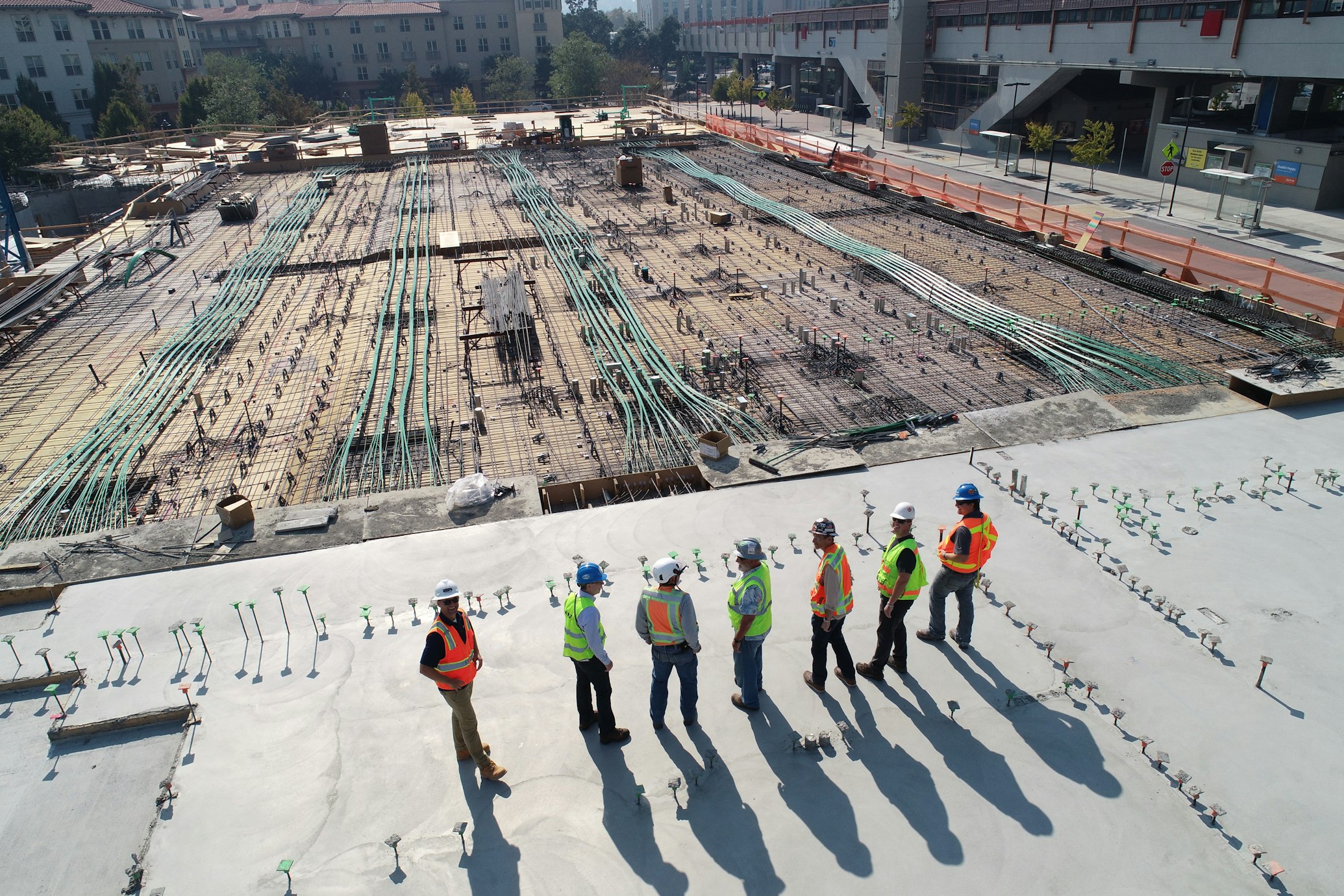
Regenerative buildings go beyond sustainability by:
Concrete production accounts for approximately 8% of global CO2 emissions. The emergence of carbon-negative concrete represents a game-changing innovation. These new formulations actually absorb more carbon dioxide than they emit during production, using materials like:
Our recently completed 45-story tower in downtown Manhattan achieved carbon neutrality through a combination of carbon-negative concrete, integrated photovoltaic glass, and an AI-driven energy management system that reduced operational energy consumption by 40% compared to similar buildings.
Materials that can repair themselves extend building lifespans and reduce maintenance costs. Recent developments include:
Artificial intelligence and the Internet of Things are revolutionizing how buildings operate. Modern sustainable structures are equipped with thousands of sensors that monitor everything from energy consumption to indoor air quality, with AI systems that:

The construction industry is embracing circular economy principles, moving away from the traditional "take-make-dispose" model. Key strategies include:
Beyond environmental benefits, sustainable construction makes strong financial sense:
As we look toward 2030, several trends will shape the future of sustainable construction:
The journey toward truly sustainable construction is accelerating, driven by technological innovation, evolving regulations, and changing market demands. For developers, architects, and builders, embracing these innovations isn't just an environmental imperative—it's a competitive advantage that will define success in the coming decade.

Michael Chen is the Director of Design and Innovation at Horizon Group, with over 15 years of experience in sustainable architecture and urban planning. His work has been featured in numerous industry publications, and he regularly speaks at international conferences on the future of construction. Michael holds a Master's in Sustainable Design from MIT and is a LEED Fellow.

Comments (12)
Sarah Johnson
Excellent article, Michael! The point about regenerative design really resonates. We've been experimenting with green roofs that support local pollinators at our latest development. Have you seen research on how these systems impact building energy efficiency?
Michael Chen (Author)
Thanks, Sarah! Yes, there's interesting research from the University of Toronto showing that extensive green roofs can reduce cooling loads by 15-25% in summer months. The key is proper irrigation and plant selection. I'll send you the study.
David Park
Great overview of where the industry is heading. I'm particularly interested in the financial aspects. Do you think the premium for carbon-negative materials will decrease as adoption increases? Right now, the cost difference is still significant for many developers.
Maria Rodriguez
This article perfectly captures the shift we're seeing in client expectations. More corporations are asking for regenerative features, not just sustainability checkboxes. The AI-driven systems you mentioned—are they accessible for mid-sized projects or only large developments?